
- Synopsis -
Inspired by true events, LUZ follows a Brazilian adman who travels alone to the Atacama Desert trying to put his life back together. Fresh out of a long relationship and a difficult stretch, he arrives in Chile closed off, ironic, and exhausted, watching the world from a distance, almost always through the lens of an astronomy binocular.
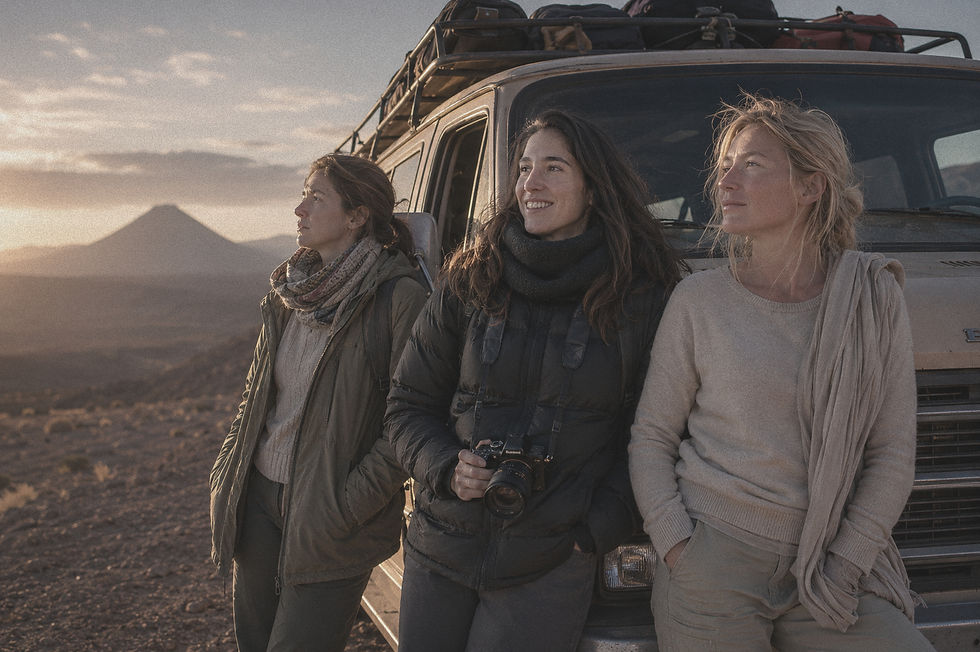
Over a handful of days, sharing a local guide's van with a group of strangers from all over the world, Eduardo crosses volcanoes, salt lagoons, and star-filled skies alongside a Chilean couple, an American couple, a Brazilian woman who believes in everything he doesn't, and a Danish woman reading Rilke.
Slowly, without realizing it, he stops watching life and begins to be part of it.
On the last dinner of the trip, a small and silent gesture reveals to Eduardo a truth that had been in front of him the whole time, one that changes the meaning of everything he has lived.

- The World -
LUZ takes place in San Pedro de Atacama, in northern Chile, the driest and highest inhabited place on Earth, where the sky is so clear it has become one of the most important stargazing sites in the world.
It's a world of dirt roads and adobe walls, of dusty vans and cheesy radio stations, of volcanoes that watch over the village and salt lagoons where the body floats on its own. A place where travelers from everywhere cross paths for a few days and move on, and where the vastness of the landscape cuts every person down to their real size.
The desert is not a backdrop in LUZ. It is the film's condition. The scale of the sky, the silence between the mountains, and the feeling of standing before something far greater than one's own life are what lead a closed-off man to begin opening up. Atacama was chosen because it is, at once, the end of the world and the place where it becomes hardest to escape yourself.

- Characters -
Eduardo Monteiro
A widowed Vietnam veteran carrying a weight no one around him can see.
Eduardo Munoz
A lifelong friend and pastor who knows when silence matters more than advice.
Luz
A gruff neighbor with a ridiculous scooter, a sharp tongue, and a bigger heart.
Bia
Lover her father across distance neither knows how to close.
Tyler
Gene's granddaughter, who holds on to him no matter what she comes to learn.
Sarah
Elijah's wife, the steady strength that holds her family and her faith together.

- Music & Tone -
LUZ carries the tone of a human comedy that slowly reveals itself as drama, without ever announcing it. There is a lot of laughter along the way, and it is the humor that earns the film the right to move you by the end.
The music comes from within the journey, not laid over it. The cheesy radio playing in the van, the seventies and eighties rock that brings strangers together at an impromptu karaoke, the Andean flute in the streets, the romantic ballads drifting across the desert. These are the songs real people would listen to, and each one carries memory and affection before it ever becomes a score.
The film was written around artists such as Inti-Illimani, Violeta Parra, Queen, Phil Collins and Leonard Cohen, among many others. The screenplay suggests specific songs, though nothing is final. They point less to a playlist than to a state of mind: warm, ironic, gently melancholic, and deeply human.

- A crossing of worlds -
LUZ brings together characters from across the world, a Brazilian, a Chilean couple, an American couple, a Danish traveler, a Korean-American photographer, each carrying their own history, culture, and way of seeing life. Strangers who meet by chance in the desert and, for a few days, become something close to a family.
The film is originally written in three languages, Portuguese, Spanish, and English, reflecting the way people from different places actually meet and communicate when travel throws them together. This is part of what makes the film feel true.
At the same time, the story is built on something universal, the human need to be truly seen by another person, which crosses any language. The structure is flexible by design: the balance of languages and the origins of certain characters can be adapted to suit the commercial and casting needs of a production, without altering the heart of the film or how it is understood.

- Screenplay -
Title: LUZ
Genre: Comedy-Drama
Format: Feature Screenplay (Final Draft)
Length: 131 pages
Languages: Spanish, Portuguese and English.
Based on: Inspired by true events.
Status: Completed (English, Portuguese and Spanish versions)
WGA Registered
In the tradition of character-driven, humanist road films set against landscapes that change the people who cross them.

- Why this story -
LUZ is a personal story. I lived it.
After a turbulent period in my life, I decided to travel alone to the Atacama Desert to clear my head. That week, surrounded by cinematic landscapes where raw, primitive nature meets a local culture full of mysticism, might have been enough to change me on its own.
What I didn't expect was that the desert would take things from me before it gave anything back. My phone burned out on the first night. The airline lost my suitcase. Stripped of the small comforts and the constant connection I didn't even know I was hiding behind, I had no choice but to be there, fully, with nothing between me and the place, the people, and myself. We live so distracted, so plugged into screens, so absent from the analog life happening right in front of us, that it sometimes takes losing all of it to actually see again.
And then, on the last day of the trip, in a simple, ordinary moment, I realized something about a man I had shared a van with for a week, one of so many travelers, each carrying their own story, and that single realization reorganized the meaning of everything I had just lived.
I won't say here what it was. It became the heart of the film.
What I can say is that it taught me something I had stopped seeing: that some people hold up the lives around them through the smallest gestures, the kind we almost never notice. How much we miss of those right in front of us. And how rare, and quietly transforming, it is to truly see another person, and to be seen.
That is the film I wanted to make.

Pasé demasiado tiempo mirando un espejo. Y estaba muy sucio.

The complete screenplay is available on request.
eduardo@officesbh.com • +55 (31) 98888-2222